ESAB ROBBI AI™ Cobot for MIG and TIG Welding Automation Brings Physical AI to the Shop Floor
New AI-powered cobot system makes real-time welding decisions, adapts to changing joint conditions and designed to
Press Release Disclaimer: This is a press release distributed through the XPR Media network. It has not been independently verified by our newsroom.


ESAB introduces ROBBI AI™, a new cobot system that uses physical artificial intelligence (AI) to sense and respond to real-world welding conditions in MIG and TIG welding. Unlike conventional approaches that rely on predefined robot paths and weld sequences, ROBBI AI uses camera and laser sensing to assess the welding environment, make decisions in real time, and adjust welding motion and process parameters as conditions change. The system is designed to eliminate the need for the operator to manually teach weld paths, including when multiple parts are fixtured on a table.
This press release features multimedia. View the full release here: https://www.businesswire.com/news/home/20261022098475/en/
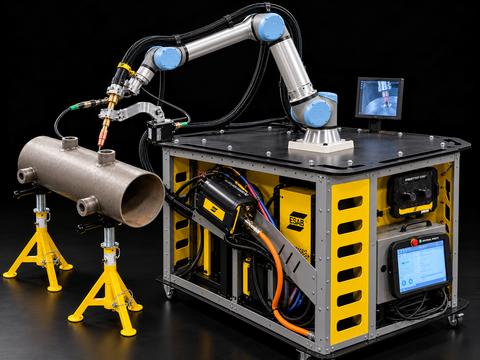
ESAB introduces ROBBI AI™, a new cobot system that uses physical artificial intelligence (AI) to sense and respond to real-world welding conditions in MIG and TIG welding.
ROBBI AI works with EWM Titan XQ, EWM Tetrix XQ or ESAB Aristo Edge power sources and is aimed at some of manufacturing’s hardest welding jobs: high-quality work on low-volume, high-mix runs and applications where joint fit-up varies. These include pipe fabrication, TIG welding and other work that requires hard-to-find skilled welders and is difficult to automate.
“Physical AI brings intelligence directly into the welding process,” says Dan Colvin, Vice President, Advanced Technology Solutions, ESAB. “Instead of programming every movement and anticipating every possible variation, ROBBI AI assesses the joint, determines how to proceed and can make adjustments while welding. It is also designed to learn from every weld, helping it recognize conditions that can lead to defects and respond by adjusting welding parameters or stopping the weld when needed.”
From Programmed Paths to Real-Time Decisions
Physical AI refers to artificial intelligence systems that can perceive, understand, make decisions about and interact with the physical world through machines, such as robots. Traditional robotic welding and other AI systems typically rely on programmed paths and consistent part fit-up. Even with seam tracking, larger variations in joint gaps or other conditions can require reprogramming, operator intervention or process adjustments. ROBBI AI takes a different approach. It generates the weld path itself, eliminating the need for manual path teaching. The operator positions the system at or near the joint, provides the welding procedure parameters from the applicable welding procedure specifications (WPS) including consumables, material type, weld type (butt, fillet, pipe, etc.) and then initiates the weld. The AI uses its sensing capabilities to evaluate the project, identify the expected joint and determine how to proceed within the parameters established for the application.
“As welding progresses, ROBBI AI can adapt its motion and welding parameters to changing conditions,” continues Colvin. “For example, if a joint gap opens or closes, the system can adjust its travel motion, oscillation or welding parameters as appropriate within the established procedure. Rather than relying solely on a predetermined weld sequence, it can make welding decisions in real time.”
The system also supports conventional cobot operation, allowing users to turn off full-AI mode and operate the robot using more traditional methods when appropriate.
Learning From the Welding Process
ROBBI AI is designed to learn from its welding experience, using data from completed welds to improve its ability to recognize and respond to changing conditions. Before deployment, the system undergoes a simulation-based learning period. Once operating in the customer’s facility, it continues to collect weld data and associated video, providing a record that can help operators investigate defects and identify opportunities for improvement. If the system detects a condition that could compromise a weld, it can stop welding. Operators can then review the recorded information to understand what occurred and provide feedback that helps the AI recognize similar conditions in the future.
The AI processing takes place locally on a computer within the customer’s facility rather than depending on continuous communication with a cloud-based system. This approach keeps the system’s learning data onsite and supports real-time decision-making at the point of welding.
“We use our existing InduSuite software to help keep AI-driven welding decisions within predefined welding procedure specifications and qualification requirements,” says Colvin. “ESAB’s approach is designed to reduce the risk of AI-driven adjustments that could result in welding outside those specifications or with an unapproved procedure.”
Addressing Difficult-to-Automate Applications
ROBBI AI is particularly suited to applications where skilled labor is difficult to find and conventional automation can be challenging to implement. TIG welding is one example, given the specialized skills and extensive practice required to master the process. Pipe fabrication for data centers and other infrastructure projects is another potential application, especially where demand is high and production capacity is constrained.
By combining sensing, adaptive welding decisions and continuous learning, ROBBI AI offers manufacturers another way to address labor shortages, accommodate part variation and expand automation into applications that have traditionally depended heavily on individual welder expertise.
“With ROBBI AI, we are extending the role of AI beyond digital analysis and into the physical welding process – where intelligent decisions can directly influence how a weld is made,” says Colvin.
Welding Power Sources
The ESAB Cobot features a Universal Robots UR10e or UR 20e industrial robot arm. It is available in a 7th axis configuration to provide a reach advantage and expand the part envelope, as well as on a wheeled cart to organize components and enables moving the cobot around a shop. Power source options include the ESAB EWM Titan XQ, EWM Tetrix XQ or Aristo Edge 500R.
The Titan XQ offers conventional, pulsed and advanced welding processes that include EWM React, which actively controls wire movement and droplet transfer to achieve up to 100% faster welding speeds, significantly higher quality results and 35% less heat input than conventional short-arc welding.
The Tetrix XQ DC and AC/DC TIG welding machines deliver versatile conventional and pulse options. EWM’s tigSpeed Drive 45 feeds the welding consumable continuously to the welding point as cold wire, similar to MIG welding, where it is melted by the arc and the weld seam is formed. Using an integrated power source, tigSpeed can preheat the welding consumable and feed it to the welding point as hot wire. This hot wire function increases the deposition rate by up to 60 percent compared to manual TIG welding.
The Aristo Edge provides advanced WeldModes that include Advanced Pulse, CRAFT, and SPEED process for the Warrior Edge 500 CX; the Warrior Edge 500 DX adds THIN, ROOT and ROOT Pipe WeldModes.
About ESAB
For more than 120 years, ESAB has been a world leader in fabrication technology. Our distinctive portfolio of fabrication solutions encompasses more than 40 of the world’s most trusted brands across welding and cutting equipment, automation, robotics, fabrication software, filler metals, gas flow control, PPE, and inspection and monitoring. Industries and innovators that shape the world rely on ESAB’s products and solutions. To learn more, visit esab.com.
View source version on businesswire.com: https://www.businesswire.com/news/home/20261022098475/en/
Media gallery