Warehouse Robotics Market Outlook Report Including Segment Evaluation and Strategic Industry Insights
The Business Research Company’s Warehouse Robotics Market Global Market Report 2026 – Market Size, Trends, And Forecast
Press Release Disclaimer: This is a press release distributed through the XPR Media network. It has not been independently verified by our newsroom.

The Business Research Company’s Warehouse Robotics Market Global Market Report 2026 – Market Size, Trends, And Forecast 2026-2035
LONDON, GREATER LONDON, UNITED KINGDOM, October 26, 2026 /EINPresswire.com/ — “The warehouse robotics sector is rapidly evolving as automation becomes a cornerstone of modern logistics and supply chain management. With growing demand for efficiency and speed in warehousing, this industry is set for substantial growth, driven by technological advancements and expanding e-commerce operations. Let’s explore the current market landscape, regional dynamics, key segments, and the factors shaping the future of warehouse robotics.
Warehouse Robotics Market Size and Its Position Within the Industrial Robots Sector
The warehouse robotics market is anticipated to exceed $9 billion by 2030. When compared to its parent market, Industrial Robots (which includes warehousing and storage robots), expected to reach around $17 billion by the same year, warehouse robotics is projected to make up approximately 57% of that market. Within the much larger Machinery industry, forecasted to be valued at $5,280 billion by 2030, warehouse robotics represents a modest but meaningful segment with nearly 0.2% of the total value.
Request A Free Sample Of The Warehouse Robotics Market Report
https://thebusinessresearchcompany.com/sample_request?id=18777580&type=smp&name=Warehouse%20Robotics%20Market%20Report%202026&utm_source=EINPresswire&utm_medium=Paid&utm_campaign=Oct_PR
Asia-Pacific Expected to Lead Warehouse Robotics Market by 2030
Asia-Pacific is set to dominate the warehouse robotics market in 2030, with a valuation of $4 billion. This figure marks an increase from $3 billion in 2025, reflecting a compound annual growth rate (CAGR) of 9%. The region’s growth is propelled by the fast expansion of large e-commerce fulfillment hubs, a surge in automated warehousing adoption within manufacturing and retail industries, rising labor costs pushing automation, robust development in logistics and last-mile delivery, and significant investments in smart warehouse technologies. Additionally, the increasing integration of robotics with advanced fleet management and real-time inventory systems is accelerating market growth in this area.
China to Remain the Largest Warehouse Robotics Market Nationally in 2030
China is projected to be the top country in the warehouse robotics market by 2030, reaching a market size of $2 billion. This growth from $1 billion in 2025 corresponds to a 9% CAGR. Key drivers include the rapid growth of domestic manufacturing and export supply chains, higher automation in port and free-trade logistics zones, government-supported industrial modernization initiatives, rising use of robotics in third-party logistics and courier services, and the need for high-speed order processing in urban distribution centers. Furthermore, ongoing advancements in AI-driven warehouse management systems across major industrial provinces contribute significantly to the market’s expansion.
Access The Detailed Warehouse Robotics Market Report Here
https://thebusinessresearchcompany.com/report/Warehouse-Robotics-global-market-report?utm_source=EINPresswire&utm_medium=Paid&utm_campaign=Oct_PR
Mobile Robots Will Dominate Warehouse Robotics by 2030
Within the warehouse robotics market segmented by type—parallel robots, mobile robots, and gantry robots—mobile robots are forecasted to be the largest, accounting for 67% or $6 billion in 2030. The rise of mobile robots is driven by widespread deployment of autonomous transport systems within warehouses, growing demand for flexible robotic solutions in high-variety order fulfillment, and the need for real-time navigation and obstacle avoidance in busy logistics environments. The integration of robotics with warehouse execution and fleet management platforms, plus the growth of robotics-as-a-service models, supports this segment’s expansion. Technological improvements in battery life and indoor positioning are enhancing operational reliability and scalability.
Key Functional and End-User Segments of the Warehouse Robotics Market
Functionally, the warehouse robotics market is divided into pick and place, transportation, and packaging segments. In terms of end users, the market serves sectors including e-commerce, automotive, food and beverages, electronics and electrical, metal and machinery, pharmaceuticals, and various others. These segments reflect the broad application of warehouse robotics across diverse industries seeking enhanced efficiency and throughput.
Projected Compound Annual Growth Rate of Warehouse Robotics Market Through 2030
The warehouse robotics market is expected to grow at a compound annual growth rate (CAGR) of 9% leading up to 2030, highlighting steady and robust expansion driven by multiple key factors.
E-Commerce Fulfillment Growth as a Major Market Driver
A significant force behind warehouse robotics growth is the rapid expansion of e-commerce fulfillment operations. E-commerce growth intensifies order volumes and fulfillment complexity, demanding advanced robotic solutions such as Automated Guided Vehicles (AGVs), Automated Storage and Retrieval Systems (AS/RS), and goods-to-person systems. As online retail accelerates, warehouses must handle more frequent, smaller orders with tight turnaround times. Robotics enhance picking speed, storage utilization, and order accuracy, enabling logistics providers to meet rising consumer expectations for same-day and next-day delivery while managing costs and scaling operations efficiently.
Increasing Demand for Enhanced Warehouse Operational Efficiency
Another critical factor boosting market growth is the rising need for operational efficiency in warehouses. Operators face pressure to process growing inventory volumes with greater speed and accuracy, prompting increased adoption of robotics to automate essential tasks like material transport, storage, retrieval, sorting, and picking. These robotic systems reduce reliance on manual labor, minimize errors, and optimize labor usage. By streamlining workflows and smoothing supply chain coordination, especially during peak seasons, robotics help warehouses increase throughput and eliminate bottlenecks, contributing significantly to market growth.
Automated Storage and Retrieval Systems Driving Market Expansion
The growing popularity of Automated Storage and Retrieval Systems (AS/RS) is also a key catalyst for warehouse robotics growth. AS/RS supports warehouse operators’ focus on optimizing space and improving storage efficiency by enabling automated inventory handling that maximizes vertical space and reduces wasted aisle area. Besides boosting storage density, these systems improve inventory accuracy, shorten handling times, and accelerate order fulfillment, making them vital to high-performance warehouse operations. This trend is expected to fuel steady growth in the robotics market.
Major Growth Opportunities Across Robot Types in Warehouse Robotics
Significant growth potential lies within the parallel, mobile, and gantry robot segments, collectively expected to add over $3.5 billion in market value by 2030. This surge is linked to expanding high-density automated storage operations, increasing use of robotics for rapid order picking and sorting in e-commerce, and rising demand for scalable automation handling diverse SKUs. Additionally, integration with AI-based warehouse orchestration and predictive task allocation, expansion of fast turnover logistics models, and advances in sensor technologies supporting precise navigation are accelerating this market. These factors reflect the broader industry trend toward digitized, efficient warehouse ecosystems.
Market Share Outlook for Robot Segments From 2025 to 2030
Over the next five years, the parallel robots market is projected to grow by $0.2 billion, mobile robots by $3 billion, and gantry robots by $0.3 billion. This growth underscores the dominance of mobile robots while highlighting steady advances in other robot types, driven by rising warehouse automation demands.
Leading Players Shaping the Warehouse Robotics Market
The market features a mix of global industrial automation giants and specialized robotics firms. Companies are focusing on autonomous mobile robots, robotic picking and sorting systems, AI-integrated warehouse management, and advanced sensor navigation to enhance operational efficiency and market positioning. Key competitive factors include supply chain optimization, labor cost reduction, scalability, and real-time inventory accuracy. Understanding the competitive landscape is crucial for stakeholders aiming to capitalize on growth and innovation within logistics automation and e-commerce fulfillment.
Top Company Leading Warehouse Robotics Market Sales in 2025
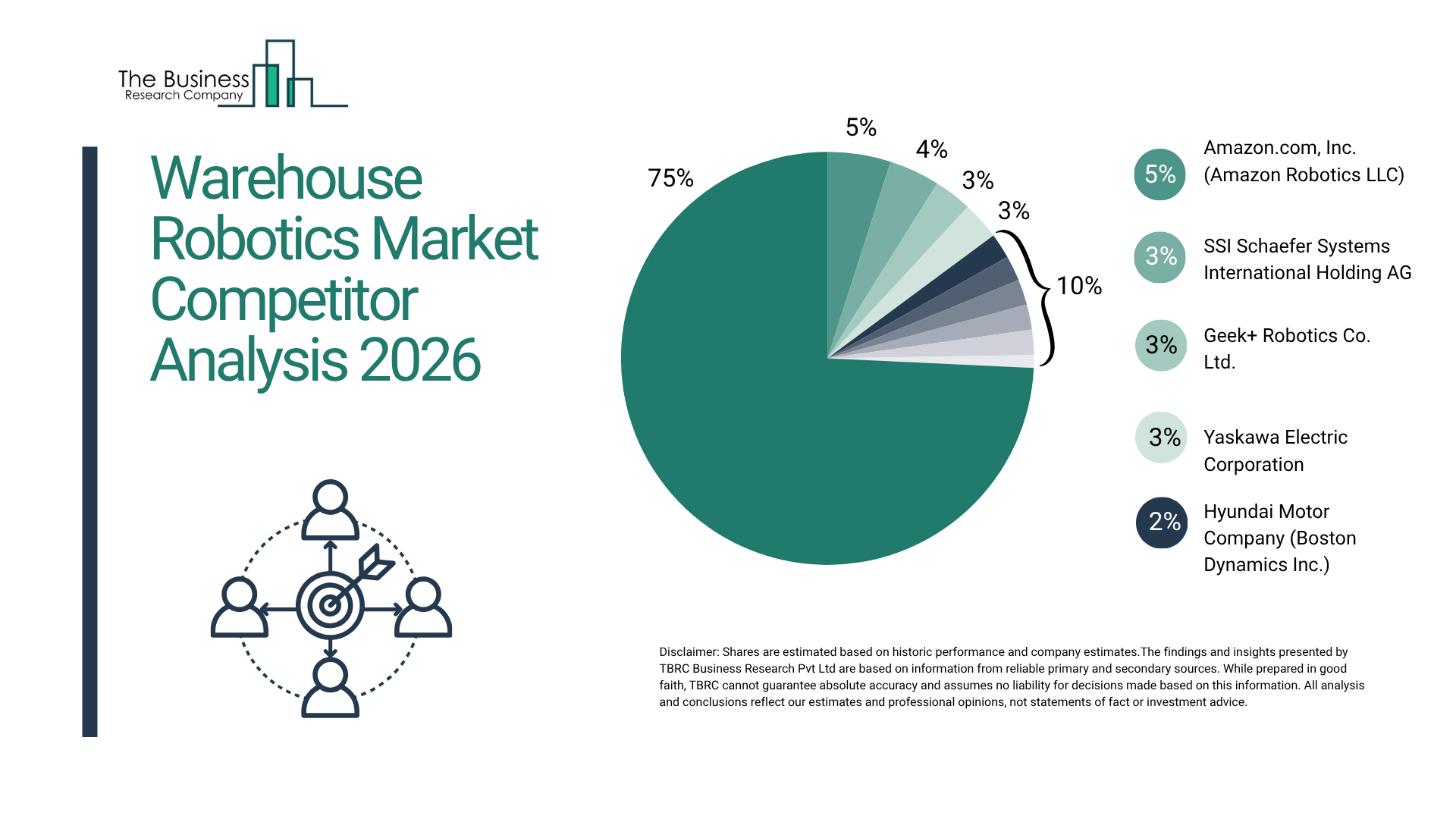
Amazon.com, Inc. (Amazon Robotics LLC) led global warehouse robotics sales in 2025 with a 5% market share. The company offers a broad portfolio of autonomous mobile robots, robotic picking and sorting technologies, warehouse automation solutions, and AI-powered fulfillment systems supporting large-scale e-commerce and logistics centers worldwide.
Notable Players Contributing to the Warehouse Robotics Industry
Key corporations involved in this market include Amazon.com, Inc. (Amazon Robotics LLC), SSI Schaefer Systems International Holding AG, Geek+ Robotics Co. Ltd., Yaskawa Electric Corporation, Hyundai Motor Company (Boston Dynamics Inc.), Toshiba Corporation, KION Group (Dematic Corp.), Daifuku Co. Ltd., ABB Ltd., FANUC Corporation, Honeywell International Inc., Rockwell Automation, Inc. (Clearpath Robotics Inc.), Teradyne (Universal Robots A/S), Yamaha Robotics, Omron Corporation, Knapp AG, Vecna Robotics Inc., RightHand Robotics Inc., Locus Robotics Corporation, IAM Robotics LLC, Mobile Industrial Robots ApS, Seegrid Corporation, Magazino GmbH, Attabotics Inc., Skild AI (Fetch Robotics Inc.), Swisslog Holding AG, and GreyOrange Pte. Ltd.
Overall Market Concentration and Competitive Dynamics
The warehouse robotics market is moderately fragmented, with the top 10 companies holding 25% of total revenue in 2025. This indicates moderate barriers to entry, driven by high capital requirements, complex integration with warehouse systems, advanced AI and machine learning needs, and demands for reliability and scalability in large logistics operations. Leading firms maintain market presence through diverse offerings, strong logistics partnerships, global deployment networks, and continuous innovation in intelligent material handling.
Key Raw Material Suppliers Supporting Warehouse Robotics Industry
Essential raw material and component providers for this market include ABB Ltd., FANUC Corporation, KUKA AG, Yaskawa Electric Corporation, Mitsubishi Electric Corporation, Siemens AG, Rockwell Automation Inc., Schneider Electric SE, Honeywell International Inc., Omron Corporation, Panasonic Corporation, Keyence Corporation, Cognex Corporation, Zebra Technologies Corporation, SICK AG, Bosch Rexroth AG, Denso Corporation, Intel Corporation, NVIDIA Corporation, Qualcomm Incorporated, STMicroelectronics N.V., Texas Instruments Incorporated, Analog Devices Inc., Epson Robots, and Nachi-Fujikoshi Corporation.
Leading Wholesalers and Distribution Channels in Warehouse Robotics
Primary wholesalers and distributors facilitating warehouse robotics equipment include Ingram Micro Inc., Arrow Electronics Inc., Avnet Inc., Tech Data Corporation, Synnex Corporation, CDW Corporation, Insight Enterprises Inc., RS Components Limited, Digi-Key Electronics, Mouser Electronics Inc., Future Electronics Inc., ScanSource Inc., WESCO International Inc., Graybar Electric Company Inc., Rexel Group, Sonepar Group, Anixter International Inc., Fastenal Company, Grainger plc, Redington Limited, ALSO Holding AG, Esprinet S.p.A., Bechtle AG, Westcon Group, and Exclusive Networks SA.
Warehouse Robotics Market End Users Across Industries
Prominent end users of warehouse robotics solutions include Amazon.com Inc., Walmart Inc., DHL Supply Chain, FedEx Corporation, United Parcel Service Inc., DB Schenker, Kuehne+Nagel International AG, XPO Logistics Inc., CEVA Logistics, Geodis SA, JD Logistics Inc., Alibaba Group Holding Limited, Flipkart Internet Private Limited, IKEA Supply Chain Operations, Target Corporation, Costco Wholesale Corporation, Carrefour S.A., Tesco PLC, Home Depot Inc., Lowe’s Companies Inc., Nestlé S.A., Procter & Gamble Company, Unilever PLC, and PepsiCo Inc.
Emerging Competitive Trends Transforming Warehouse Robotics
Autonomous fulfillment systems are revolutionizing warehouse robotics by enabling robots-to-goods processes, boosting productivity, and reducing reliance on manual labor. For instance, in April 2026, Locus Robotics introduced its Locus Array autonomous fulfillment system at MODEX 2026 in Atlanta. This system combines mobile robots, robotic picking arms, and AI-driven perception with the LocusONE orchestration platform to automate entire warehouse workflows, increase throughput, and support scalable 24/7 operations with minimal human intervention.
Strategies Companies Are Employing to Maintain Market Leadership
Leading companies in warehouse robotics are focusing on enhancing autonomous robotic systems and AI to improve fulfillment speed and accuracy. They are adopting robots-to-goods architectures to maximize space utilization and operational efficiency. Additionally, investments in expanding warehouse automation infrastructure aim to boost supply chain throughput, while integrating machine learning with robotics allows for real-time order fulfillment and greater adaptability in dynamic warehouse environments.
What’s new in our 2026 market reports:
• Market attractiveness scoring and analysis
• Total addressable market (TAM) analysis
• Company scoring matrix graphics and tables
• Excel dashboards
• Market hotspots infographics
• Key technologies and future trends
• Updated graphics and tables
Learn More About The Business Research Company
The Business Research Company (www.thebusinessresearchcompany.com) is a leading market intelligence firm renowned for its expertise in company, market, and consumer research. We have published over 30,000+ reports across 27 industries and 60+ geographies. Our research is powered by 1,500,000 datasets, extensive secondary research, and exclusive insights from interviews with industry leaders.
We provide continuous and custom research services, offering a range of specialized packages tailored to your needs, including Market Entry Research Package, Competitor Tracking Package, Supplier & Distributor Package and much more.
Disclaimer: Please note that the findings, conclusions and recommendations that TBRC Business Research Pvt Ltd delivers are based on information gathered in good faith from both primary and secondary sources, whose accuracy we are not always in a position to guarantee. As such TBRC Business Research Pvt Ltd can accept no liability whatever for actions taken based on any information that may subsequently prove to be incorrect. Analysis and findings included in TBRC reports and presentations are our estimates, opinions and are not intended as statements of fact or investment guidance.
Contact Us:
The Business Research Company
Americas +1 310-496-7795
Europe +44 7882 955267
Asia & Others +44 7882 955267 & +91 8897263534
Email: marketing@tbrc.info
Follow Us On:
LinkedIn: https://in.linkedin.com/company/the-business-research-company“
Oliver Guirdham
The Business Research Company
+44 7882 955267
info@tbrc.info
Visit us on social media:
LinkedIn
Facebook
X
Legal Disclaimer:
EIN Presswire provides this news content “as is” without warranty of any kind. We do not accept any responsibility or liability
for the accuracy, content, images, videos, licenses, completeness, legality, or reliability of the information contained in this
article. If you have any complaints or copyright issues related to this article, kindly contact the author above.

Media gallery